
The Leverage Ratio
Renting frontier performance on a small-model balance sheet — what VibeThinker-3B proves, and a simple experiment that found part of the premium already gone

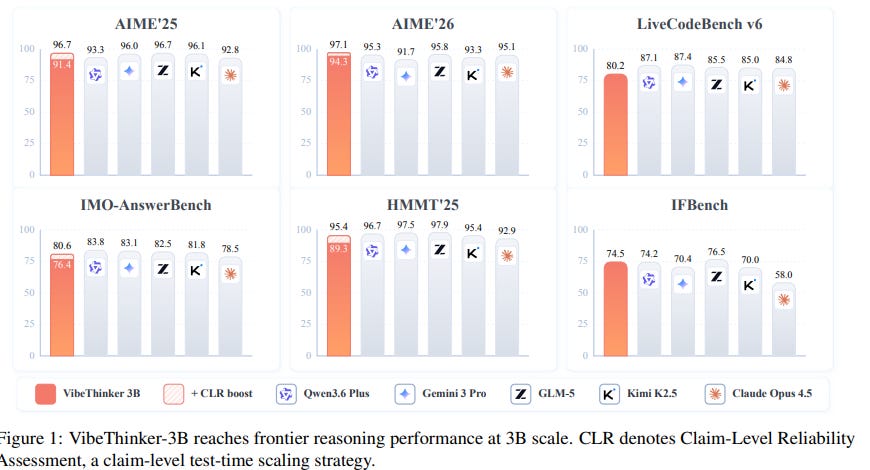
Interesting Finding: Weibo AI’s VibeThinker-3B lands a 3-billion-parameter model inside the frontier score band on verifiable reasoning — 94.3 on AIME26 — using a post-training pipeline most readers cannot afford to replicate, while its Claim-Level Reliability Assessment adds +2.8 points at test time with zero weight updates.
This article surveys four ways to lift any small open-weights model toward frontier performance, argues on token-economics grounds that the first dollar should go to a harness rather than to weights, and pre-registers E-LK1: a three-arm, twenty-problem experiment implementing a CLR-lite harness around hosted small models. The experiment then ran, live, for $0.415 total — and partially falsified its own premise. Don’t worry - it’s interesting. I know i have made similar assumptions about “the newest-bestest” models I see.
A stock Qwen3-8B scored 100% across every arm, tying the frontier reference exactly: on constructed competition-style math, the premium I set out to rent has already collapsed for a competent 2025-generation small model. Where a gap did exist — Qwen3.5-9B, a 2026-generation model handicapped by chronic overthinking (7,469 output tokens per call, 74% completion rate at a 16K ceiling) — the harness closed 67% of it, squarely inside the pre-registered 40–70% band, with the lift concentrated in the predicted tiers. The generation ‘upgrade’ was negative on this task class (Qualification: Context, model parameters, fine-tuning etc would quite easily change the outcome of any given task): raw capability that cannot terminate is not capability you can bank. The leverage thesis survives in a stronger, stranger form: the rentable gap has moved up — to genuinely hard verifiable work, and to the long-horizon agentic regime where training-free control frameworks are now beating GPT-4-class agents with 8B backbones.
The Plain-English Version. Frontier AI models are expensive; tiny free ones have quietly gotten good. I asked a simple question: can you make a cheap small model perform like an expensive one — not by training it, but by wrapping it in a checking routine (a ‘harness’) that makes it answer four times, fact-check its own claims, and vote on the best answer? We tested this on 20 math problems with known answers, wrote our predictions down first, and spent $0.42 in total. Three things happened:
1. The gap I wanted to close had already closed itself. The free 2025 small model (Qwen3-8b) tied the expensive frontier model (Sonnet 4.6) outright:
small model (2025, ~$0.05/M) = frontier model (~$3/M) [100% = 100%]
2. Newer isn’t better. The 2026 small model (qwen3.5-9b) lost to its own predecessor — not because it’s less smart, but because it ‘overthinks’: it writes so much reasoning it runs out of room before stating the answer.
new small model, alone (85%) < old small model, alone (100%)
3. The harness works exactly where a gap exists. Wrapping the struggling model in the checking routine recovered two-thirds of its shortfall, for pennies:
new model + harness (95%) > new model alone (85%)
harness (cents) << fine-tuning ($5-50) << training your own (GPU-months)
The takeaway for a general reader: before paying frontier prices for any task with a checkable answer, test whether a free small model already does the job — it increasingly does. Where it falls short, a dollar’s worth of ‘answer, check, vote’ closes most of the remaining distance. Save the expensive model for whatever fails the check.
1 · The 3B Signal
In June 2026, Weibo AI released VibeThinker-3B [1], a dense 3-billion-parameter model post-trained from Qwen2.5-Coder-3B. The headline numbers are difficult to dismiss: 94.3 on AIME26 against DeepSeek V3.2’s 94.2 at 671B parameters; 89.3 on HMMT25; a 96.1% first-attempt acceptance rate on LeetCode weekly contests from April–May 2026, problems published after any plausible training cutoff. On tasks where an answer can be checked, a model 223× smaller than DeepSeek V3.2 and 333× smaller than Kimi K2.5 sits in the same score band.
The authors’ explanation is the Parametric Compression–Coverage Hypothesis: verifiable reasoning — search, constraint satisfaction, error correction inside a structured solution space — compresses into a small reasoning core, while open-domain knowledge is a coverage problem that genuinely needs parameters. The evidence is in their own table: VibeThinker-3B trails badly exactly where coverage matters (70.2 on GPQA-Diamond versus 91.9 for Gemini 3 Pro) and nowhere else. This is the same asymmetry the ISR Fusion Lab series kept finding from the harness side: architecture wins on verifiable work and buys almost nothing on open-ended work.
The number in the paper that matters most for practitioners, though, is not 94.3. It is the gap between 94.3 and 97.1 — the boost from Claim-Level Reliability Assessment (CLR), a test-time strategy that samples candidate solutions, extracts the decision-relevant claims from each, has the model falsify or validate its own claims, and picks the answer cluster with the highest reliability-weighted mass. No gradient touched a weight. The pipeline that produced the checkpoint cost GPU-months; the last 2.8 points cost tokens. That asymmetry is the subject of this article — and, as the results below show, the asymmetry runs even deeper than the paper implies.
2 · Four Ways to Lift a Small Model
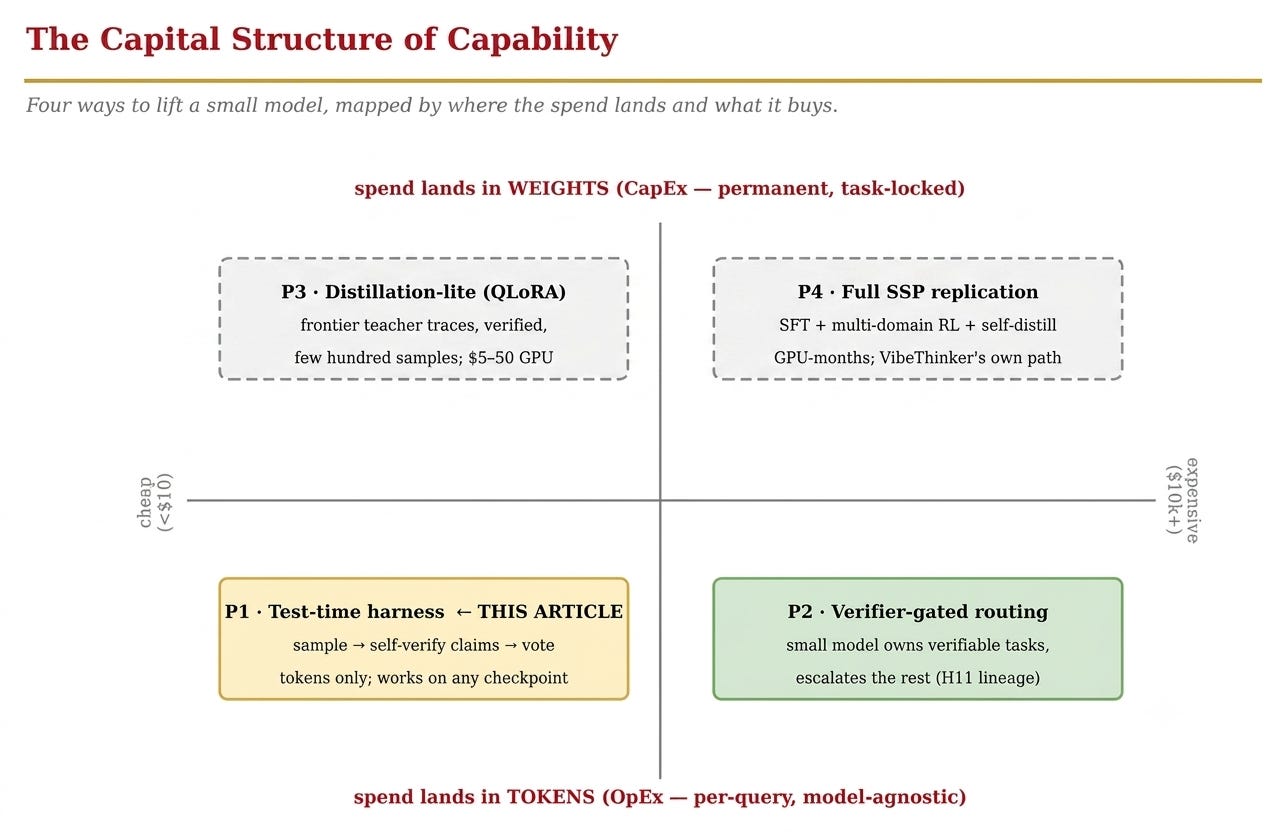
Suppose you hold any competent small open-weights checkpoint and want frontier-grade output on a domain you care about. There are four distinct places to spend, and they differ less in technique than in capital structure: whether the spend lands in weights (permanent, task-locked, CapEx) or in tokens (per-query, model-agnostic, OpEx).
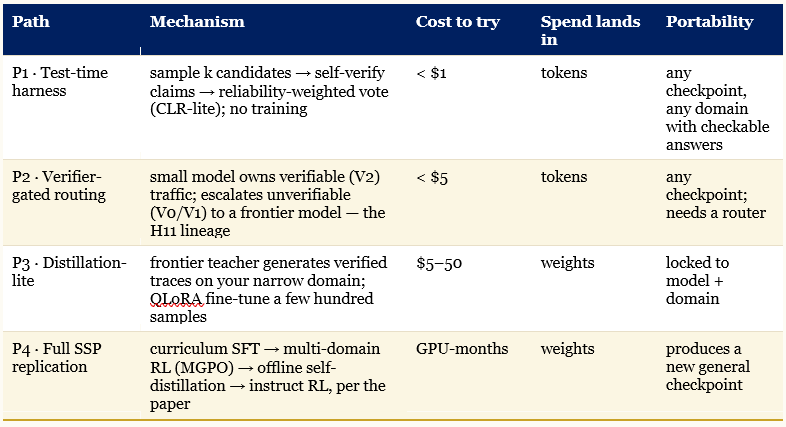
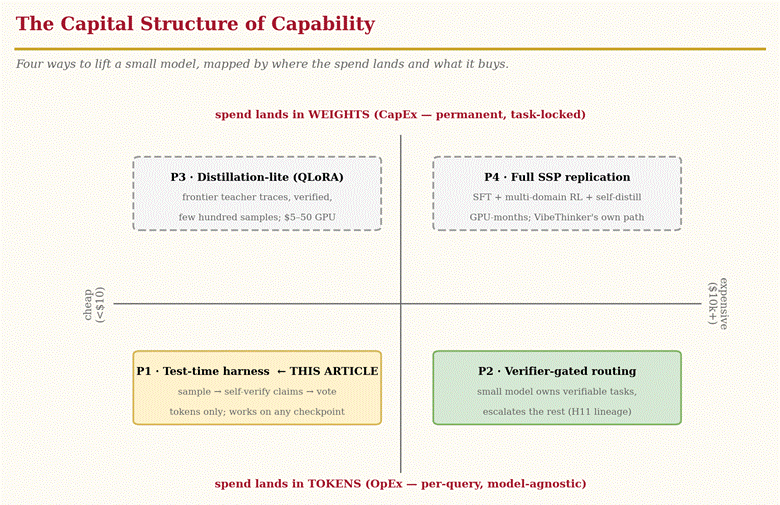
Figure 1. The capital structure of capability: where each lift path puts the spend, and what it buys.
P4 is what Weibo AI did, and it is out of reach for an individual budget. P3 is the classic distillation move and remains right when you need low latency on a fixed narrow task. P2 is where my earlier Verifiable Router work points — but it presupposes you already know how much lift the small model can achieve on its verifiable slice, which is precisely the unknown. That makes P1 the right first experiment on strict dominance grounds: cheapest, no B200s GPU, works on any hosted checkpoint unchanged, and it directly measures the quantity every other path depends on. It is also the paper’s own mechanism tested at the opposite end of the curve, where the self-consistency literature says the headroom is far larger [3, 4, 5].
3 · Why the First Dollar Goes to the Harness
Read the four paths as a financing decision. Fine-tuning is buying the asset: high upfront cost, illiquid, value locked to one model generation — and small-model generations are depreciating fast, with a stronger base checkpoint shipping roughly quarterly. A harness is renting the capability: zero commitment, instantly re-hostable onto whatever checkpoint is best this month, and its cost scales with usage rather than ahead of it. The Balance Sheet of Intelligence argued that tokens are construction costs, not operating costs — you spend them to build verified artifacts. The harness sharpens that: the same tokens that produce the answer also produce the verification evidence.
The literature says the rent is cheap. Self-consistency voting alone lifted smaller models double-digit points on math benchmarks [3]; repeated sampling shows coverage climbs log-linearly in k across model sizes [4]; and test-time compute, allocated well, can beat spending the same FLOPs on a much larger model [5, 6]. VibeThinker’s CLR result [1] adds the missing piece: a claim-level self-verifier converts coverage into selection even when the verifier is the generator. The open question was what fraction of the small-to-frontier gap this recovers at the bottom of the curve, per dollar. Measuring it cost forty-one and a half cents.
4 · The Lift Kit: CLR-lite in a Hundred Lines
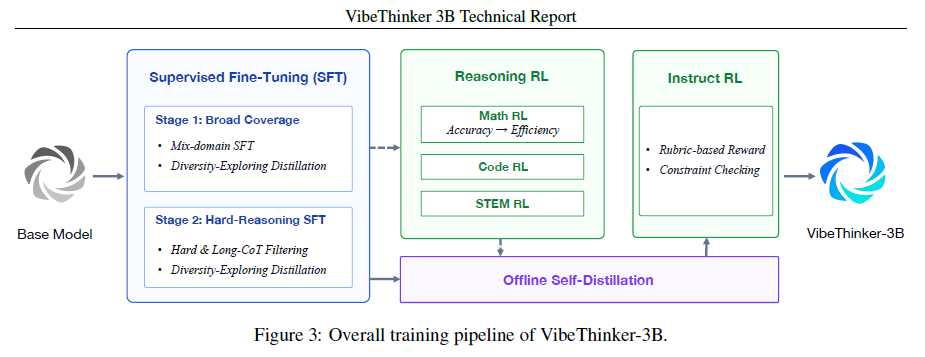
First, what I am not rebuilding. VibeThinker’s checkpoint quality comes from the Spectrum-to-Signal pipeline: two-stage curriculum SFT builds a broad solution space, MaxEnt-guided RL amplifies correct signals near the model’s capability boundary, and offline self-distillation folds the elicited trajectories back into one student [1, 2]. Figure 2 condenses it — not to replicate it, but to locate the wedge we exploit: everything left of the output arrow is CapEx already paid by someone else the moment weights are open-sourced. CLR sits to the right of it.
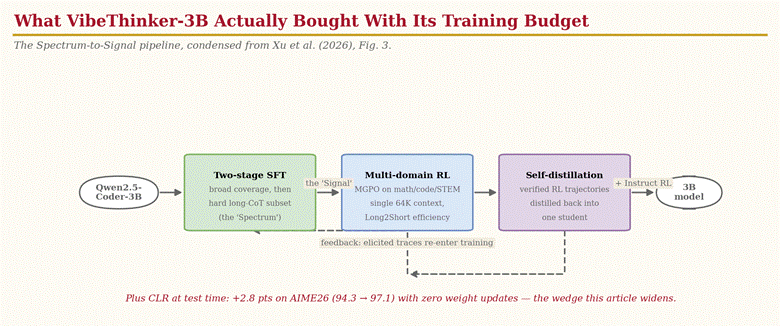
Figure 2. The Spectrum-to-Signal pipeline, condensed from Xu et al. (2026). The training stages are sunk CapEx; the CLR wedge at test time is the part that is rentable.
The Lift Kit is a deliberately minimal CLR implementation on the standard four-stage skeleton (Orchestrate / Generate / Aggregate / Decide). Per problem: the runner samples k = 4 candidate solutions at temperature 1.0, each instructed to emit exactly three CLAIM lines — decision-relevant intermediate facts — plus a boxed final integer. Each claim is checked by the same small model in a separate, short TRUE/FALSE call that sees only the problem and the claim, never the full trajectory. A candidate’s reliability is r = (mean verdict)^3, the paper’s nonlinear Eq. 5 with M = 3, which punishes any flawed link in the chain much harder than a linear average would. Equal answers are clustered and the cluster with the largest summed reliability wins (Eq. 6). Malformed candidates are dropped, every call is metered, and a hard budget abort kills the run if projected spend crosses the ceiling.
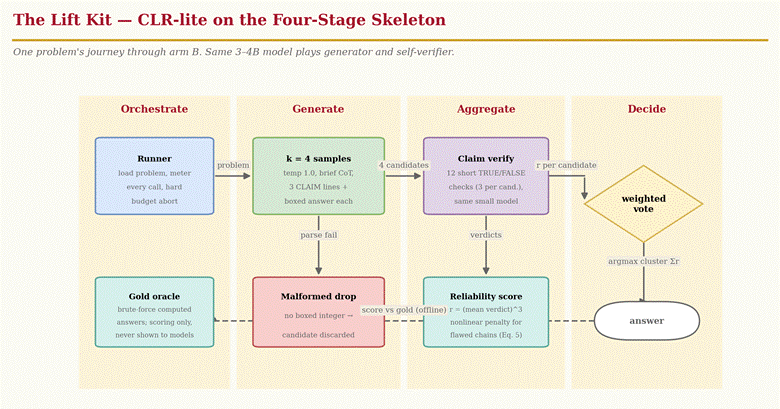
Figure 3. The Lift Kit: one problem’s journey through arm B. The same small model plays generator (green) and self-verifier (purple); the gold-answer oracle (teal) touches scoring only, never the models.
5 · E-LK1: What Was Actually Run
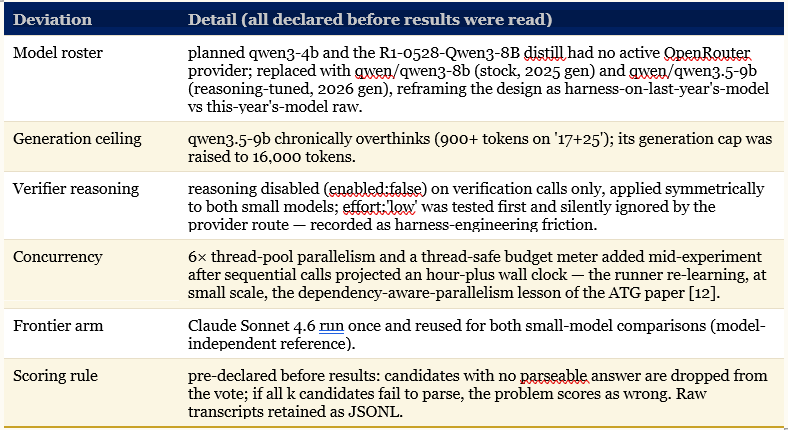
The experiment followed my usual protocol: gold answers fixed before any model ran, predictions published before results, and every deviation logged. The task set is a small 20 constructed math problems in four difficulty tiers — constructed rather than scraped to minimize string-level contamination, with every gold answer brute-force computed in Python. That protocol earned its keep immediately: a memorized sanity value for the trailing zeros of 2026! said 504; the computation said 505. One wrong ‘known’ answer in twenty is exactly the base rate that makes machine-computed golds non-negotiable. The harness pipeline was validated end-to-end against stub models (360 metered calls) before any live spend.
6 · Results vs. the Pre-Registration
Failures first, per the find-failure protocol. Total live spend: $0.415 across 628 API calls.

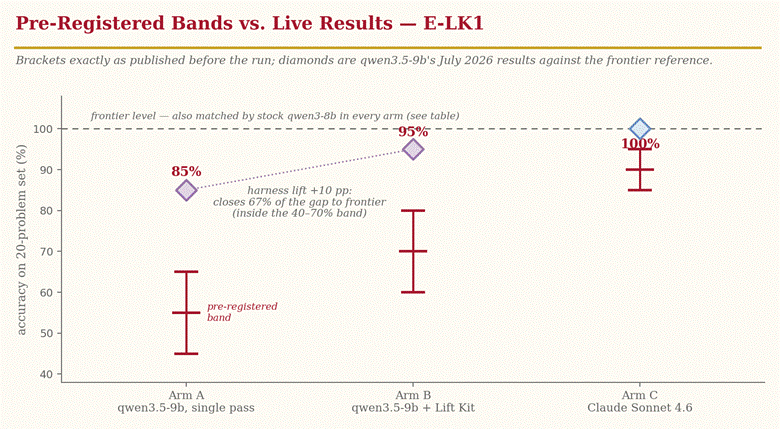
Figure 4. The pre-registered prediction bands, published unchanged, with the live results overlaid — as promised before the run.
Pre-registered prediction
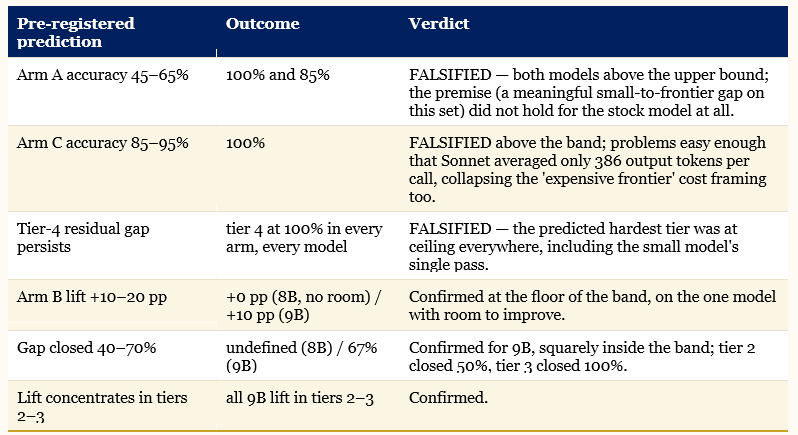
Finding 1 — the premium is partly gone. The central premise — that current small open-weights models meaningfully trail a frontier model on constructed competition-style math — did not survive contact with July 2026. A stock Qwen3-8B tied Claude Sonnet 4.6 at 100% on its first pass. Two honesty caveats before this is over-read: with n = 20, a model whose true accuracy is 90% passes all twenty about 12% of the time, so 100% means ‘at or above roughly 85–90% with confidence,’ not perfection; and while the problems were freshly constructed, the techniques (CRT, derangements, modular exponentiation, casework counting) are textbook — precisely what reasoning-RL pipelines have spent eighteen months distilling into small checkpoints. The set was contamination-resistant at the string level and saturated at the technique level. The instrument, designed against 2025 intuitions, was too blunt for 2026.
Finding 2 — where a gap existed, the harness closed two-thirds of it. Qwen3.5-9B’s raw arm scored 85%; the harness lifted it to 95%, closing 67% of its gap to the frontier — inside the pre-registered 40–70% band, with every point of lift in tiers 2–3, exactly as predicted. This is the one clean confirmation the ceiling left available, and it landed almost dead-center.
Finding 3 — the verbosity tax, measured. The 2026-generation model did not lose to the 2025 model on reasoning; it lost on termination. It averaged 7,469 output tokens per call against 2,098 — 3.6× the spend per candidate — and even at a 16,000-token ceiling only 74% of its candidates produced a parseable answer, against 100% for the stock model. Problem P08 was lost entirely: zero of eight sampled candidates across both arms finished, an infrastructure ceiling-hit rather than a reasoning failure, scored as wrong under the pre-declared rule. Its 85% raw score is therefore a blend of genuine misses and answers it never finished writing. Raw capability that cannot terminate is not capability you can bank — and the harness’s value on this model was less ‘smarter selection among reasoning paths’ than fault tolerance: recovering correct answers from whichever candidates survived the model’s own verbosity. That recovery function was not in the original design intent, and it may be the more durable one.
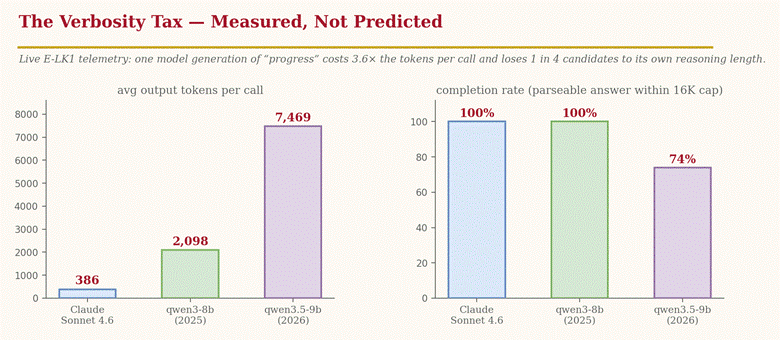
Figure 5. The verbosity tax: one model generation of ‘progress’ costs 3.6× the tokens per usable call and loses a quarter of its candidates to non-termination.
The rent-vs-buy question answered itself ironically: last year’s model raw beat this year’s model raw and harnessed. On this task class the generation upgrade was negative, because the new model’s additional capability arrives wrapped in a verbosity tax it cannot pay down within any practical ceiling. Completion rate — the fraction of responses that terminate with a usable answer inside a fixed token budget — deserves promotion to a first-class metric alongside accuracy in any small-model evaluation.
7 · The Runbook: Reproducing E-LK1
The kit ships as a small set of stdlib-only Python files: make_problems.py (regenerates and re-verifies every gold answer by brute force), problems.json, liftkit_runner.py (all arms, CLR-lite harness, 6× concurrency, token metering, hard budget abort, raw JSONL transcripts), and a beginner GUIDE.md. One environment variable (OPENROUTER_API_KEY), no pip installs.
The protocol: verify golds locally; run a two-problem pre-flight at a $0.10 cap to confirm auth, answer extraction against the real model’s output format, and pricing; then the full run under a $3 hard cap. The full two-model experiment reported here completed in under an hour of unattended wall clock for $0.415.
Practical lessons (i call these silly mistakes) that cost debugging cycles and are now folded into the kit: check that a model slug has an active provider before designing around it; expect thinking models to need both a raised generation ceiling and reasoning disabled on short verdict calls (and expect some providers to silently ignore the polite version of that request); and parallelize within arms — the slow unit is the longest single call, not the call count.
8 · Strategic Outlook: The Ratio Moved Up a Level
The article set out to measure how cheaply frontier performance on verifiable work could be rented. The answer, for constructed competition-style math in mid-2026, is that much of it no longer needs renting: the old frontier is the new floor, available in a stock 8B checkpoint at five cents per million tokens. VibeThinker-3B’s Parametric Compression–Coverage Hypothesis [1] predicted reasoning would compress into small cores; the market has now shipped that compression as a commodity. The leverage question therefore moves up a level, to the two places a gap still lives.
The first is genuinely hard verifiable work — problems where technique-matching fails and search actually binds. E-LK1’s instrument saturated before it could measure there; a successor set (E-LK2) with larger search spaces and un-nameable techniques is the obvious follow-up, and the pre-registration discipline carries over unchanged. The second is the long-horizon agentic regime, and here the convergent evidence is striking: the Atomic Task Graph framework [12] — training-free, pure control structure, decomposing tasks into dependency-explicit DAGs with parallel execution and localized repair — lifts a Llama-3-8B past GPT-4-with-ReAct on ALFWorld and WebShop, cuts execution steps by a fifth against the best structured baseline, and drops hallucinated-action rates from 43% to 12%. Their conclusion, that improving the control framework can substitute for backbone scaling, is this article’s P1 quadrant restated by an independent group on a different task class. The caveats: dated backbones, a GPT-4-era frontier bar, and a two-week-old preprint — convergent evidence, not proof.
The covenants stand, with one addition. The lift exists only where verification exists. The verifier must not share the generator’s failure modes — and E-LK1 adds: nor its termination failures, since a verifier that drowns in its own reasoning returns no verdict at all. And the harness does not create capability; it selects among capabilities the checkpoint latently has — including, it turns out, capabilities the checkpoint has but cannot reliably finish expressing. On this evidence the playbook is: take the best small open checkpoint of the quarter, measure its completion rate before its accuracy, wrap it in a hundred lines of sample-verify-vote where a gap exists, and spend the frontier budget only on what fails verification.
Every pre-registered band in this article was published before the run and appears in Figure 4 unchanged, with the live results overlaid — the falsifications displayed at the same size as the confirmations. The premise partly failed; the protocol did not. No issues since i did impose criteria and budgets. p.s. i get bored sometimes
References:
[1] Xu, S., Liu, S., Wang, W., et al. (2026). VibeThinker-3B: Exploring the Frontier of Verifiable Reasoning in Small Language Models. Weibo AI. arXiv:2606.16140 · github.com/WeiboAI/VibeThinker
[2] Xu, S., Zhou, Y., Wang, W., et al. (2025). Tiny Model, Big Logic: Diversity-Driven Optimization Elicits Large-Model Reasoning Ability in VibeThinker-1.5B. arXiv:2511.06221
[3] Wang, X., Wei, J., Schuurmans, D., et al. (2022). Self-Consistency Improves Chain of Thought Reasoning in Language Models. arXiv:2203.11171
[4] Brown, B., Juravsky, J., Ehrlich, R., et al. (2024). Large Language Monkeys: Scaling Inference Compute with Repeated Sampling. arXiv:2407.21787
[5] Snell, C., Lee, J., Xu, K., Kumar, A. (2024). Scaling LLM Test-Time Compute Optimally Can Be More Effective than Scaling Model Parameters. arXiv:2408.03314
[6] Muennighoff, N., Yang, Z., Shi, W., et al. (2025). s1: Simple Test-Time Scaling. arXiv:2501.19393
[7] Jain, N., Han, K., Gu, A., et al. (2024). LiveCodeBench: Holistic and Contamination-Free Evaluation of Large Language Models for Code. arXiv:2403.07974
[8] Luo, M., Tan, S., Wong, J., et al. (2025). DeepScaleR: Surpassing O1-Preview with a 1.5B Model by Scaling RL. Notion blog; cited as [16] in Xu et al. (2026).
[9] OpenRouter model catalog and pricing (accessed July 2026). openrouter.ai/models — hosting availability shifted during the experiment; slugs verified against the live catalog at run time.
[10] WeiboAI/VibeThinker-3B model weights (MIT). huggingface.co/WeiboAI/VibeThinker-3B
[11] Prior series: The Fusion Fallacy; The Verifiable Router (ISR F-1); The Balance Sheet of Intelligence; The Sovereignty Dividend. Substack, 2025–2026.
[12] Zhang, Y., Chen, S., Huang, Z., et al. (2026). Atomic Task Graph: A Unified Framework for Agentic Planning and Execution. arXiv:2607.01942
Worth remembering:
OpenRouter's shared serving amortizes idle GPU time across thousands of customers.
My whole experiment was cheap because I rented the small models “by the sip” (“pay per use”) — like paying per ride on the bus. Someone else owns the vehicle and keeps it full of other passengers, so idle time costs us nothing.
Therefore, I suggest you also read Avi Chawla's article which covers what happens if you buy the bus — run the models on your own rented GPUs. Then you pay for the hardware by the hour whether it's working or sitting idle, and the standard tools force each small model onto its own GPU. Result: five "cheap" models on five mostly-idle cards can cost as much as the expensive model you were escaping.
So the addition is one warning: small models are only cheap if the hardware under them stays busy. Rent “by the sip” while you're experimenting (as we did — 42 cents); if you ever self-host, making the models share GPUs is its own engineering problem, not a detail.
https://blog.dailydoseofds.com/p/why-small-models-alone-dont-reduce?utm_source=profile&utm_medium=reader2&open=false