
The Balance Sheet of Intelligence
First-Principles Engineering Trade-offs, from 4-Bit Silicon to Agentic Loops

Why Everything in AI Is a Trade
I spent years in accounting, finance, investments, and corporate finance (optimizing business value) before I spent slightly fewer years in (what have become industry buzzwords) - Machine Learning, Computer Vision, Natural Language Processing (NLP), then Deep Learning (trading algorithms for a hedge fund identifying “alpha” before terms like Algorithmic Trading or High Frequency Trading (HFT) even became “cool”). So it was not too difficult to take the tiny leaps from all that to ChatGPT……Agentic AI, Loop Engineering, Harness Engineering etc. - and the longer I run various experiments, the more the two disciplines collapse into one. A balance sheet has a property that makes it useful: it cannot (generally) lie about scarcity/abundance. Every asset is financed by a liability or by equity; you cannot conjure resources on one side without recording their source on the other. AI engineering in 2026 feels like it has exactly this property, and the field’s best work is best understood as double-entry bookkeeping against physics.
The reason is simple and, once stated, obvious. We no longer operate in the regime where the answer to any performance question is “add more.” Training runs are bounded by the energy a facility can draw, inference is bounded by how fast weights can be pulled from memory, model attention is bounded by a quadratic cost that no amount of marketing can repeal, and the humans supervising agents are bounded by the oldest constraint of all: hours in a day (yes, still very much critical in highly regulated industries). When every resource is at its limit, brute force stops being a strategy, and allocation becomes the entire game. Bryan Catanzaro’s framing of NVIDIA’s recent work crystallized this for me: at the physical frontier, the job is not to apply more force but to be more thoughtful about the force you have and how and where you direct it.
This article works through that thesis across “four ledgers”. The silicon ledger, where the currency is joules and bits. The model ledger, where it is FLOPs per token and attention. The harness ledger — my own mini laboratory for almost two years of experiments — where it is context tokens and tool calls. And the human ledger, where it is review time and trust. The claim is not that these layers are analogous in a poetic sense. The claim is stronger: they are the same optimization problem, and techniques provably migrate between them.
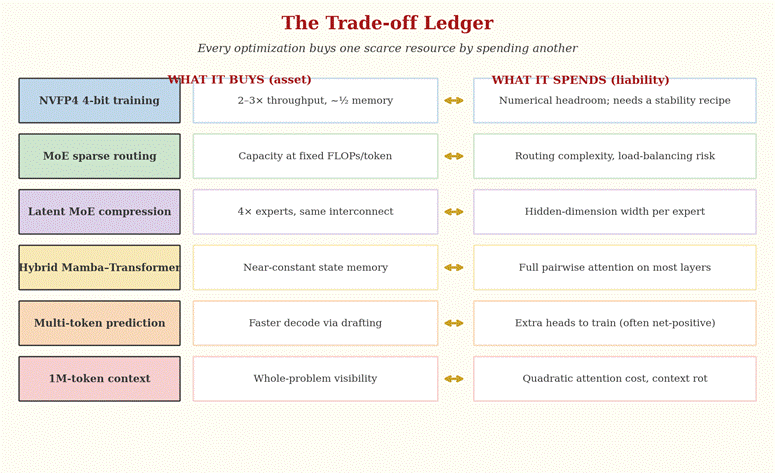
Figure 1. Six flagship optimizations of the current hardware-software generation, written as ledger entries. Each buys a scarce resource by spending another; none is free.
II. The Silicon Ledger
The precision trade: buying throughput with bits
Start at the bottom of the stack (reflected at the top in Figure 1), where the trades are most nakedly physical. NVIDIA’s NVFP4 work demonstrated stable pretraining of a 12-billion-parameter model on ten trillion tokens using 4-bit floating point, matching the loss curves of an FP8 baseline. The headline economics are stark: on Blackwell-class hardware, 4-bit matrix math runs at roughly two to three times FP8 throughput while halving operand memory. In an energy-bounded facility, that is not an incremental gain — it is the difference between one training run and two.
But the ledger must balance, and what 4-bit precision spends is numerical headroom. An E2M1 value can represent only sixteen distinct magnitudes. The entire NVFP4 contribution is the offsetting entry: a recipe of algorithmic inventions that buys the dynamic range back. Blocks of sixteen values share an FP8-precision scale factor, with a full-precision scale above that to catch outliers. Weights are scaled in two-dimensional blocks so the forward and backward passes see the same quantized values and the chain rule survives. Random Hadamard transforms smear outliers across the tensor before quantization. Stochastic rounding is applied to gradients — and pointedly not to activations, where it hurts — to remove systematic rounding bias. A handful of sensitive layers stay in higher precision.
Notice the structure of the solution, because it recurs at every layer of this article: the constraint (sixteen representable magnitudes) is not fought head-on. It is routed around with structure — grouping, scaling, transformation, selective exemption. Structure substitutes for resources. I have been writing versions of that sentence since “The Structure Is the Intelligence,” and it was strange and satisfying to find it holding four bits above the transistor.
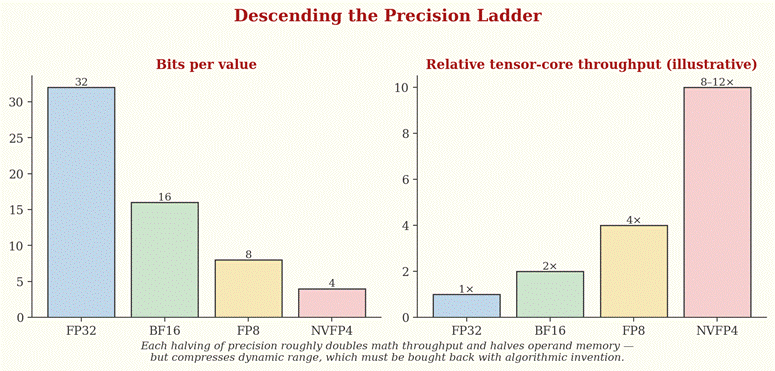
Figure 2. The precision ladder. Descending a rung roughly doubles arithmetic throughput and halves memory, but each descent must be financed by a stability recipe: microscaling, 2D block scaling, Hadamard transforms, stochastic rounding.
The real cost of inference is the wire, not the math
The second entry on the silicon ledger corrects a widespread misconception. The expensive operation in modern inference is usually not the multiplication; it is reading the weights out of memory to do the multiplication. Arithmetic units have scaled faster than memory bandwidth for a decade, so a GPU generating tokens autoregressively spends much of its life waiting on DRAM. Once you internalize that, a family of otherwise disconnected techniques snaps into a single pattern: do more useful work per byte moved.
Latent MoE, introduced in the Nemotron 3 Super and Ultra architectures, is the cleanest illustration I know. In a conventional mixture-of-experts (MOE) layer distributed across GPUs, the full-width hidden vector of every token must cross the interconnect to reach its assigned experts. NVLink is fast, but it is a budget like any other. The latent variant down-projects the vector into a narrow latent space before it touches the wire, runs the experts on the compressed representation, and re-expands afterward. The bandwidth saved is spent immediately — on roughly four times as many experts at the same inference cost. NVIDIA reports the trade nets out favorably: better accuracy per parameter than standard granular MoE designs. The liability side is real (each expert operates on a narrower representation), but the exchange rate between bandwidth and capacity was lopsided enough to exploit.
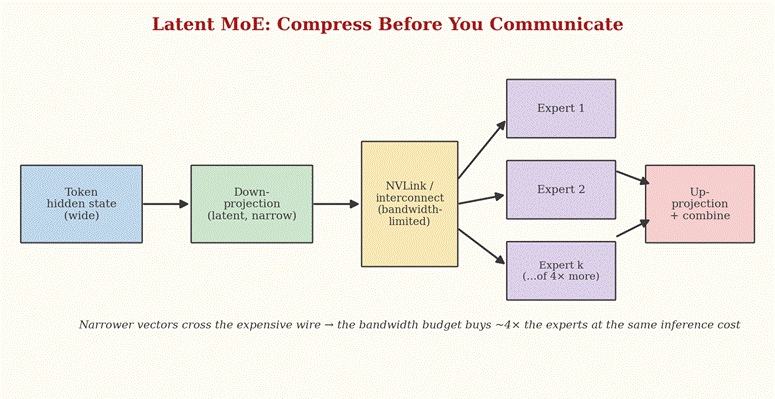
Figure 3. Latent MoE as a bandwidth arbitrage. Compressing the token representation before the interconnect converts a communication budget into model capacity — four times the experts for the same inference cost.
Paying rent on memory: the hybrid architecture
A pure transformer pays rent on every token it has ever seen: the KV cache grows linearly with sequence length, and attention cost grows quadratically. For the agentic workloads this series studies — long-running loops, tool transcripts, million-token repository contexts — that rent structure is ruinous. The hybrid Mamba-Transformer designs in the Nemotron 3 family are a renegotiated lease. State-space layers carry a fixed-size recurrent state regardless of sequence length, handling the bulk of long-range carrying, while a minority of interleaved attention layers preserve the precise random-access recall that pure SSMs sacrifice. Nemotron 3 Ultra pushes the pattern to 550B total parameters with 55B active and a one-million-token window, claiming up to six times the inference throughput of comparable open models. The trade: you give up uniform exact attention everywhere and accept an architecture bet that most tokens do not need it. The workload data increasingly says the bet is correct.
The rare positive-sum entry
Most ledger entries are zero-sum by construction, which is what makes multi-token prediction (MTP) interesting: it is the exception that proves you should always audit the sign of a trade rather than assume it. MTP trains additional heads to predict several future tokens per forward pass. Naively this reads as a speed-for-accuracy swap — draft fast, verify, accept some rejections. But because the draft heads share the model’s representations and are trained jointly, a more accurate model produces better drafts, better drafts raise the acceptance rate of speculative decoding, and higher acceptance means fewer expensive full passes. Accuracy improvements compound into speed improvements. The Nemotron reports describe MTP heads sharing parameters precisely to make this drafting robust. When a system is architected so that its quality metric and its efficiency metric point the same direction, you have found something better than a trade-off — you have found a flywheel. These are rare, and finding one is worth months of searching.
FINANCE LENS
In capital structure terms: most optimizations are asset swaps — you exchange one resource for another at some rate, and skill is negotiating the rate. Multi-token prediction (MTP) is closer to refinancing at a lower coupon: the same asset base now services itself more cheaply, and the savings compound. Portfolio thinking applies — a stack should hold mostly well-priced swaps and hunt aggressively for the occasional refinancing.
III. The Model Ledger
Sparsity as leverage
Mixture-of-experts (MOE) is the model ledger’s use of leverage, in the precise financial sense: control over a large asset base with a small active commitment. Nemotron 3 Ultra holds 512 experts per MoE layer and activates the top 22 per token; 550B parameters of stored knowledge are serviced by 55B parameters of per-token compute. The router is the credit officer, deciding which capital gets deployed against which query. And like all leverage, it introduces fragility in exchange for capacity — load-balancing failures, routing collapse, and training instabilities are the margin calls of sparse models. The engineering literature of the past two years is substantially a risk-management manual for this leverage: auxiliary-loss-free balancing, expert parallelism schemes, capacity factors. None of it would be necessary in a dense model. All of it is cheaper than the dense model’s compute bill.
The context window as working capital
A million-token context window is best understood as working capital: capacity you keep liquid so operations never stall for lack of information. More is genuinely useful — whole-repository comprehension, multi-hour agent sessions, and unfragmented retrieval all improve with visibility. But working capital is not free; it is financed. Every token in context participates in attention, occupies cache, and dilutes the model’s finite attention budget across more pairwise relationships. Anthropic’s engineering guidance names the resulting failure mode context rot: recall accuracy degrades as the window fills, before any hard limit is reached. The implication is the same one a CFO would draw about idle cash — the goal is not maximum working capital but optimal working capital, the smallest set of high-signal tokens that funds the task.
MOPD and Conway’s ledger
The most underrated entry on the model ledger is organizational. A frontier lab wants one model that is excellent at mathematics, code, science, and tool use — but it employs hundreds of researchers organized into teams that each want to maximize their own domain. A single monolithic training objective turns those teams into rivals for gradient signal: a tug-of-war in which one specialty’s gain is another’s regression, and every training run becomes a political negotiation. Multi-teacher on-policy distillation, used in Nemotron 3 Ultra’s post-training, is a mechanism-design solution disguised as an ML technique. Each team trains its own specialist teacher to the limit of its domain; distillation then transfers the specialists’ strengths into one student model. The technical trade — some fidelity loss per domain in exchange for a coherent generalist — is real but modest. The organizational trade is the actual prize: teams optimize independently, on their own schedules, without contending for a shared objective.
The Average Trap:
The Death of the Generalist: Market of Specialists > AGI?

The quest for a monolithic AGI is undergoing a rigorous deconstruction. Theoretical research now identifies the “Average Trap” (or Generalist’s Penalty) as the primary bottleneck to scaling. As a single model attempts to master a near-infinite spectrum of tasks, it encounters conflicting optimization gradients that force it to trade away expert-level ac…
Conway’s law says systems mirror the communication structures of the organizations that build them. MOPD is the rare case of engineering the implication backwards: choosing an architecture because it induces a better organization. Anyone who has coordinated multiple agents in a harness — or multiple analysts on a deal team — will recognize the move.
PRINCIPLE
When a technical architecture and an organizational architecture must coexist, the binding constraint is usually the organization. Techniques that decouple contributors — distillation from independent teachers, typed interfaces between agents, verifier gates between generation and integration — pay twice: once in the metric, once in the calendar.
IV. The Harness Ledger: The Same Physics at My Desk
Everything above happens in facilities most will never enter, on budgets with nine zeros (or more). The reason this series exists is my conviction that the identical discipline operates on consumer hardware, possibly with an OpenRouter-type key. The harness ledger’s scarce currencies are context tokens, tool-call budgets, and model invocations — and almost two years of experiments keep producing the datacenter’s findings in miniature.
Decomposition is the harness’s quantization
Anthropic’s StockPilot/CMA decomposition experiment reflects a clear result: a monolithic analysis task consuming 274K tokens was restructured — typed intermediate state, staged sub-tasks, explicit hand-offs — into a pipeline consuming 9K tokens, a 97 percent reduction with no loss in output quality. At the time I framed it as “the structure is the intelligence.” I would now frame it as the same entry NVFP4 books: the resource (context, bits) is compressed brutally, and the compression is made survivable by structure (typed state, block scales). The Token Tax series (E1–E11) generalized the accounting: in agentic systems, tokens are not a metering detail, they are the unit of account, and workflows that do not budget them explicitly are running an unaudited business.
The coordination tax: H2 versus H9
The Harness Lab benchmark (H1–H10) produced the finding I am asked about most. On greenfield, single-turn tasks, a well-structured single prompt (H2) scored α = 0.920 while a five-agent swarm (H9) scored α = 0.625 — the elaborate architecture lost to the disciplined simple one by a wide margin. The datacenter analogue is exact: multi-agent systems, like multi-GPU systems, pay a communication tax, and Anthropic’s own multi-agent research measured it at up to fifteen times the token consumption of single-agent chat. Parallelism is leverage, and leverage only pays when the task decomposes cleanly enough that the coordination cost is small relative to the work distributed. Latent MoE earns its interconnect tax through compression; H9 did not earn its coordination tax at all on tasks H2 could hold in one context. My H11 architecture (“The Fusion Fallacy”) pre-registers exactly this question: whether verifier-gated sequential fusion can price the coordination tax correctly where naive fan-out cannot.
Context engineering is bandwidth engineering
Anthropic’s context engineering guidance — treat context as a finite resource with diminishing marginal returns; curate the smallest high-signal token set; prefer just-in-time retrieval over preloading; keep tool sets minimal enough that tool choice is unambiguous — reads, from the silicon ledger’s vantage, like a memory-hierarchy manual. Preloaded context is DRAM you pay to keep hot; retrieval tools are a cache-miss path; compaction is garbage collection; sub-agents with isolated contexts are NUMA domains. My seven-tier memory taxonomy (forthcoming) was an attempt to give the harness a hierarchy as explicit as the hardware’s, and the tier I flagged as unmeasured — T3, typed task-coordination state — is precisely the layer Latent MoE optimizes in silicon: the representation that crosses between workers. The wire is always the expensive part. The harness just calls the wire a context window.
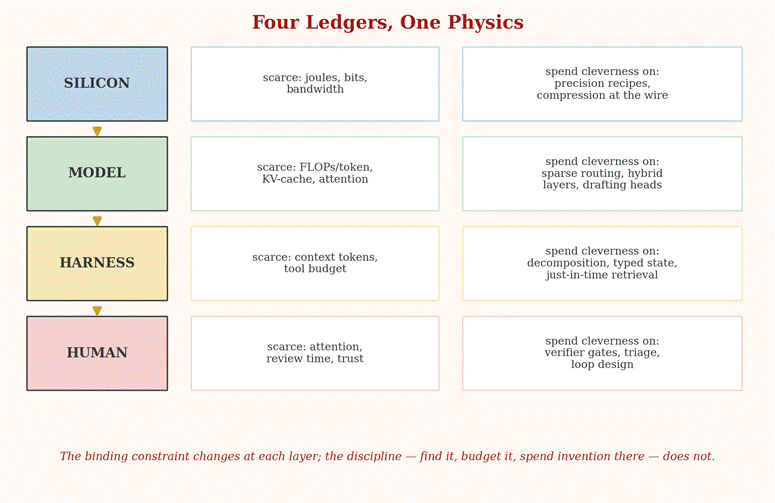
Figure 4. Four ledgers, one physics. The scarce currency changes at each layer of the stack; the discipline — identify the binding constraint, budget it, spend invention exactly there — is invariant.
V. The Human Ledger
The verification liability
The fastest-growing liability in agentic engineering does not appear in any token bill: it is human verification time. Addy Osmani’s recent work on agentic code review assembles the uncomfortable data. Reviewing agent-authored pull requests takes dramatically longer — one figure he cites puts the overhead at over four times — because the reviewer is no longer checking a colleague’s visible reasoning but reconstructing intent that was never written down; the agent’s thinking trace is discarded the moment the diff lands. A study of more than thirty-three thousand agent-authored PRs found that while roughly a quarter merge almost immediately, agents tend to abandon the review conversation when feedback turns subjective, and reviewer or author abandonment accounts for a large share of rejections. The proposed remedies — cheap up-front triage of PRs by predicted review effort, fast-tracking trivial changes, refusing to invest an hour of scarce human attention in a sprawling change the agent will orphan — are portfolio management applied to attention. Generation has been deflated to near zero; verification is now the scarce factor of production, and every serious workflow design question reduces to where you spend it.
Loop engineering: the human exits the inner loop
The clearest signal of where the human ledger is heading came in June, when Boris Cherny — who built Claude Code — described his current workflow in one line: “My job is to write loops.” He no longer prompts models directly; systems of loops discover work from issues and feedback channels, act on it, verify results against explicit goals, and escalate to him only at the boundary. Osmani promptly named the pattern loop engineering and mapped its primitives — goal conditions, scheduled discovery, sub-agent maker-checker separation, externalized memory — onto shipping product features. Two design constraints make such loops trustworthy rather than reckless, and both are ledger entries. First, the verifier must be separate from the generator; an agent grading its own output is a machine for agreeing with itself. Second, state must live outside the model — in files, in git, in project memory — because the model itself is stateless and lessons that stay inside one chat are lessons paid for and thrown away. Readers of “The Loop is the Lab” will recognize the eight primitives; what changed in 2026 is that Perceive, Evaluate, and Govern stopped being my framework’s aspirations and became product surface.
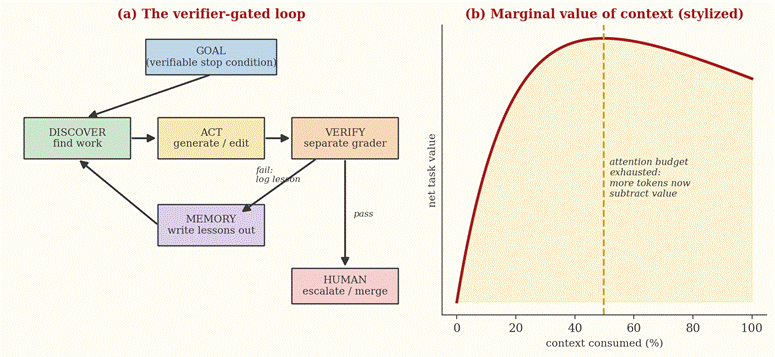
Figure 5. (a) The verifier-gated loop: generation and grading are separated, failures are written to external memory, and the human sits at the escalation boundary rather than inside the loop. (b) The stylized economics of context: marginal token value declines and eventually goes negative — the argument for budgets over maximalism.
Allocating compute like a venture portfolio
Inside the labs, the scarcest human-adjacent resource is GPU allocation, and the mechanism Catanzaro describes for rationing it is one I know intimately from venture: bootstrapping. Researchers do not receive compute in proportion to ambition; they receive small allocations, must demonstrate signal quickly, and earn larger tranches on evidence. This is staged financing — seed, series A, series B — applied to experiments, and it prices the same risk venture pricing does: most ideas fail, failure information is cheapest when purchased early, and the portfolio’s return is dominated by correctly identifying the few ideas worth concentrating in. My own mini lab runs the identical policy at consumer scale. Every experiment begins with a cheap falsification pass on a small model pool before any expensive run is authorized; the pre-registered hypotheses in “The Fusion Fallacy” exist precisely so that the kill decision is mechanical rather than sentimental.
Monoculture as concentration risk
The final human-ledger entry is the open-versus-closed question, which the trade-off frame clarifies considerably. The case for closed development is control: fewer actors, tighter release discipline. The case Catanzaro presses for openness is that control purchased through opacity carries a hidden liability — monoculture. A small number of closed labs converging on similar architectures, similar alignment recipes, and similar blind spots is, in portfolio terms, a concentrated position with correlated failure modes; openness is diversification, buying resilience with sunlight and community evaluation at the cost of proliferation risk. I do not think the ledger settles the debate — reasonable analysts weight those liabilities differently — but it at least forces both sides to book their liabilities instead of advertising only their assets.
VI. Co-Design: Reading All Four Ledgers at Once
The deepest idea at the end of the day, in the current hardware generation, is not any single technique but the practice that produced them: co-design, the refusal to optimize any layer in isolation. NVFP4 exists because Blackwell tensor cores natively execute it; Latent MoE exists because NVLink budgets are known at architecture time; MTP exists because speculative decoding was already the deployment plan; the hybrid Mamba pattern exists because the target workload — long-running agents — was specified before the architecture was. Each layer’s binding constraint becomes the next layer’s design brief, and the flywheel turns in both directions: hardware shapes algorithms, and algorithmic demand shapes the next hardware.
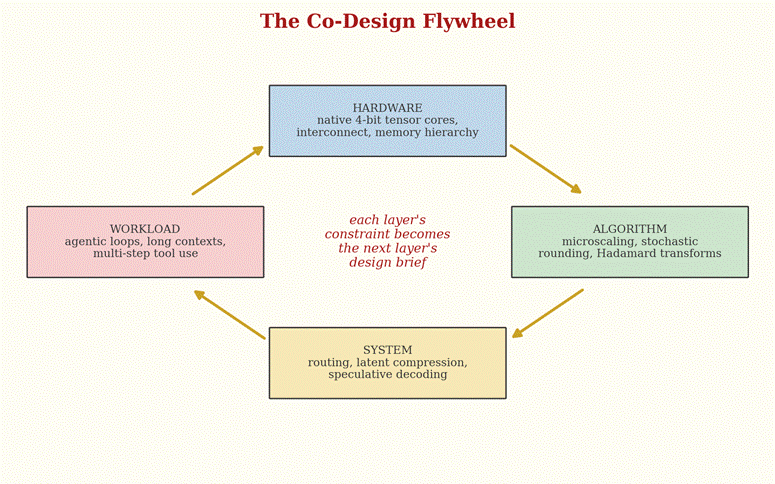
Figure 6. The co-design flywheel. No layer is optimized in isolation: hardware capabilities license algorithms, algorithms enable systems, systems serve workloads, and workload demand specifies the next hardware.
Here is the part that seems obvious only after you see it. The independent practitioner (yours truly, and so many others like me) now runs the entire flywheel alone. When I choose a model pool on OpenRouter, I am indirectly doing hardware (compute provider allocation) selection. When I design typed intermediate state, I am doing algorithm work. When I wire a verifier gate and a memory file, I am doing systems. When I decide which experiments earn a bigger budget, I am doing capital allocation. The stack that once required an organization chart now fits inside one person’s working method — which means the practitioner’s competitive advantage is exactly the labs’ advantage: the ability to hold all four ledgers in view simultaneously and notice when an entry on one can be financed cheaply from another. That is what harness engineering is. It was never a collection of tips. It is co-design at desk scale. We have all that, at our fingertips! Simply WOW!
VII. So Here We Are: A Practitioner’s Heuristics
First, find the binding constraint before optimizing anything, because effort spent on a non-binding constraint is written off in full. In most agentic workloads today the binding constraint is not model intelligence; it is context quality or human verification time, and the fastest wins come from budgeting those explicitly.
Second, when you must compress a resource, finance the compression with structure. Four-bit training survives on block scales and transforms; a 97 percent token reduction survives on typed state and staged hand-offs. Compression without structure is just loss.
Third, audit the sign of every trade, because occasionally one is positive-sum. Multi-token prediction turned an apparent speed-accuracy trade into a flywheel; in the harness, a good verifier does the same, simultaneously raising quality and reducing the human review budget. Hunt for these.
Fourth, price coordination honestly. Parallelism — of experts, of GPUs, of agents, of research teams — always levies a communication tax, and the H2/H9 result is a standing reminder that the tax can exceed the entire return. Pay it only when the decomposition is clean, and compress whatever must cross the wire.
Fifth, separate the generator from the grader everywhere: draft heads from acceptance checks, agents from verifiers, researchers from allocation committees, authors from reviewers. Self-graded work is the accounting fraud of intelligent systems — the books always balance and the business is always failing.
And last, keep the whole balance sheet in view. The era rewards neither the pure hardware thinker nor the pure prompt thinker but the practitioner who can trace a constraint from a DRAM read, through an attention budget, through a context window, to an hour of human review — and knows at which layer this particular problem is cheapest to solve.
LAB NOTE
Every claim in this paper that originates from my own experiments — the 274K→9K StockPilot decomposition, the H2 (α=0.920) vs H9 (α=0.625) benchmark, the Token Tax series, the T1–T7 memory taxonomy — was produced on consumer hardware with Claude Code and OpenRouter-routed model pools, and each has a published methodology in prior or upcoming issues. The external claims are drawn from the primary sources in the reference table. Where the two agree, I take it as weak evidence that the physics really is scale-invariant; where they diverge, that divergence is the next experiment.
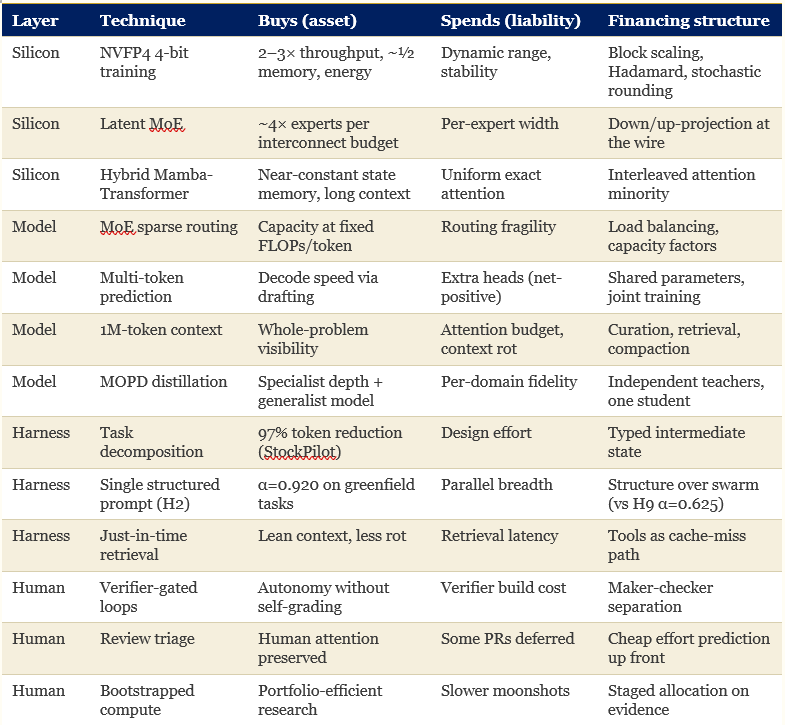
Appendix: The Consolidated Trade-off Ledger
References
[1] NVIDIA. Pretraining Large Language Models with NVFP4. arXiv:2509.25149 View on
alphaXiv · NVIDIA Technical Blog
[2] NVIDIA. Nemotron 3 Super: Open, Efficient Mixture-of-Experts Hybrid Mamba-Transformer Model for Agentic Reasoning. arXiv:2604.12374View on
alphaXiv · Technical Report (PDF) ·
[3] NVIDIA. Nemotron 3 Ultra: Open, Efficient Mixture-of-Experts Hybrid Mamba-Transformer Model for Agentic Reasoning (550B-A55B; LatentMoE, MTP, NVFP4, MOPD, 1M context). arXiv:2606.15007 ·
[4] NVIDIA. Inside NVIDIA Nemotron 3: Techniques, Tools, and Data That Make It Efficient and Accurate. NVIDIA Technical Blog
[5] Anthropic. Effective Context Engineering for AI Agents. anthropic.com/engineering
[7] Osmani, A.. Agentic Code Review. addyosmani.com
[8] Osmani, A., et al.. Loop engineering essays and The New SDLC With Vibe Coding (with S. Saboo and S. Kartakis). addyosmani.com
[11] Karpathy, A.. Vibe coding (2025) and agentic engineering (2026) as a structure-and-verification spectrum. Public posts; see also reference [8].
[12] Prior issues cited in text: The Structure Is the Intelligence; Token Tax E1–E11; The Harness Experiment (H1–H10); Memory Is the Architecture (T1–T7)-pending; The Loop is the Lab; The Fusion Fallacy (H11).
The verification liability may be the most important entry in the entire ledger. Separating the generator from the grader is essential, but the next step is making that separation enforceable at the execution boundary—so prohibited actions are not merely detected or reviewed, but prevented from completing.